Entryway Ideas That Make Small Homes Feel Bigger (and Actually Function)
A designer's playbook for entryways under 30 square feet — the console depth, mirror size, hook height, and storage system that make a tiny foyer look intentional instead of cluttered.

The entryway is the first room a guest sees and the last one you notice when you leave — which is exactly why so many small entryways end up as an accidental dumping ground of shoes, mail, and mystery keys. This is the designer playbook for entryways under about 30 square feet: what to buy, what to skip, and the measurements that keep a tight space from feeling cramped.
Why small entryways are hard
Small entryways carry an outsized workload. Every person who lives in or visits the home passes through them, and each pass leaves something behind — a coat, an umbrella, a package, a set of keys. Without a system, the visible clutter compounds until the entryway becomes the least-photographed room in the house. The good news is that solving this doesn't require more square footage. It requires the right five pieces in the right five spots.
Measure the footprint first
Before buying anything, measure three things: the wall width available for a console or bench, the door swing (how far it opens into the room), and the pinch point — the narrowest distance between the front door and any adjacent wall or furniture. You need at least 30 inches of clear circulation from the door swing to the closest object; less and the entry feels like a hallway you're squeezing through. If the pinch point is under 30 inches, skip the console entirely and go straight to a wall-mounted shelf plus hooks.
The right console
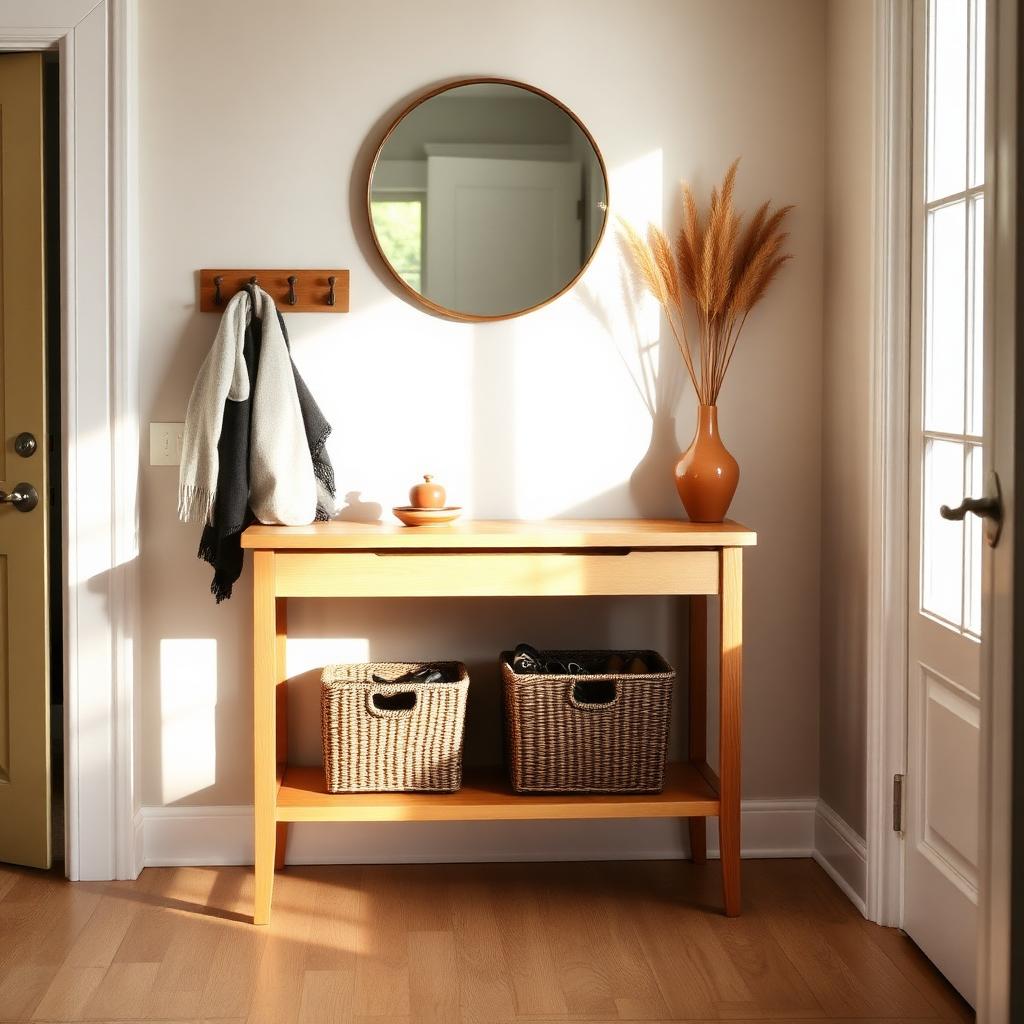
The single most impactful piece in a small entryway is a slim console table — typically 10 to 14 inches deep and 30 to 42 inches wide. Anything deeper than 14 inches steals circulation; anything narrower than 30 inches looks accidental. Choose one with a lower shelf for baskets or shoes, and legs (not a solid base) — visible floor underneath makes the whole space read as larger. Oak, walnut, and painted MDF all work; avoid glass tops in an entry, since they show every set of keys tossed onto them.
Mirror size and placement
Every small entryway needs a mirror, and most people buy one too small. The mirror should be roughly two-thirds the width of the console below it, and hung so the center sits at the eye height of the shortest adult in the household — typically 57 to 62 inches from the floor. A generous round mirror is the safest bet: it softens the boxy geometry of a hallway and bounces light back into the space. If the entry has no natural light at all, place the mirror opposite (or perpendicular to) the strongest artificial light source rather than in a dark corner where it just reflects shadow.
Hooks: height and spacing
Hooks are the workhorses of a small entry and the piece most people install at the wrong height. Adult coat hooks sit best at 66 to 72 inches from the floor. Space them 6 to 8 inches apart — closer and coats overlap into a bulky pile, farther and you waste wall space. If children live in the home, add a second row of hooks at 42 to 48 inches so they can hang their own jackets without an adult's help. A wall-mounted rail with four to six hooks does more work per square foot than freestanding coat racks, which eat floor space and always fall over.
Storage that hides the clutter
The visible surface of a small entry should stay 80 percent empty; everything else needs a home behind a door, in a lid, or inside a basket. Two matching woven baskets on the console's lower shelf handle daily shoes. A small lidded box on the console top absorbs keys, sunglasses, and mail. If the space allows, a shallow shoe cabinet (18–24 inches deep) tucked against the wall hides seasonal footwear the household actually wears. Skip the "shoes on the floor by the door" default — visually it doubles the perceived clutter of the space.
Lighting a small entry
Overhead lighting alone makes a small entry feel institutional. Layer two sources: a warm ceiling fixture (2700K–3000K) as the ambient wash, and either a small table lamp on the console or a wall sconce at eye height for warmer accent light. In the evening, use only the accent light — it's the single biggest upgrade to how welcoming a home feels when you walk in after dark. Smart bulbs on a "coming home" schedule that turns on 15 minutes before sunset take this from thoughtful to automatic.
The rug question
A rug does two jobs in an entryway: it defines the zone visually and it traps grit before it travels into the rest of the home. Pick a low-pile, washable rug sized to at least match the console width. Runners work well in long, narrow entries; a small rectangle works in a square foyer. Avoid deep-pile rugs — they hide dirt and are miserable to vacuum around shoes.
Color and material palette
Small entries benefit from a slightly warmer palette than the rest of the home. A creamy off-white on the walls, warm oak or walnut on the console, brass or aged bronze on the hardware, and one grounding accent (terracotta, deep green, or navy) in the rug or a piece of art. Keep the palette to three materials and two accent colors — more than that and the small space starts to feel busy the moment anything is set down.
Renter-friendly options
Renters can build a full entryway system without touching the walls. Choose a freestanding console with a lower shelf, a leaning full-length mirror that also handles the "how do I look" check, and a coat rack tree only if the pinch point genuinely allows one. Adhesive Command hooks handle up to five pounds each and remove cleanly — enough for jackets, hats, and dog leashes. A shallow shoe bench with a hinged lid gives you seating, storage, and a landing pad without any drilling.
Common mistakes
The five mistakes that ruin small entryways: (1) a console table deeper than 14 inches; (2) a mirror too small for the wall; (3) hooks installed at 60 inches so coats brush the console; (4) open shoe storage that immediately shows every pair; (5) a single harsh ceiling light with no accent layer. Fix any two of these and the entry looks noticeably more considered; fix all five and it looks professionally designed.
Year-round rotation
Small entries can't hold every jacket, hat, and bag the household owns year-round. Keep only the current season on the hooks and in the baskets; store the rest in a closet elsewhere. Rotate at each solstice. The rotation is a five-minute job that keeps the entry breathing rather than slowly suffocating under six months of accumulated stuff.
Frequently asked questions
- How deep should a small entryway console be?
- 10 to 14 inches. Deeper than 14 inches steals circulation space and makes the entry feel narrower than it is.
- What height should coat hooks be installed at?
- Adult hooks: 66 to 72 inches from the floor. Kids' hooks: 42 to 48 inches. Space each hook 6 to 8 inches apart.
- Do I really need a mirror in the entryway?
- Yes — it bounces light, doubles the perceived size of the space, and gives you the final outfit check on the way out. Aim for a mirror roughly two-thirds the width of the console.
- How do I keep shoes from cluttering a small entry?
- Two matching baskets on the console's lower shelf for the current-week rotation, plus a closed shoe cabinet if the footprint allows. Everything else lives in a closet.
Frequently asked questions
- How deep should a small entryway console be?
- 10 to 14 inches — deeper steals circulation and makes the entry feel narrower than it is.
- What height should coat hooks be installed at?
- Adult hooks 66–72 inches from the floor, kids' hooks 42–48 inches, spaced 6–8 inches apart.
- How large should the entryway mirror be?
- Roughly two-thirds the width of the console, hung so its center sits at eye height (57–62 inches).
- How do I stop shoes from cluttering the space?
- Two matching baskets on the console's lower shelf for the current week, plus a closed shoe cabinet if the footprint allows.